
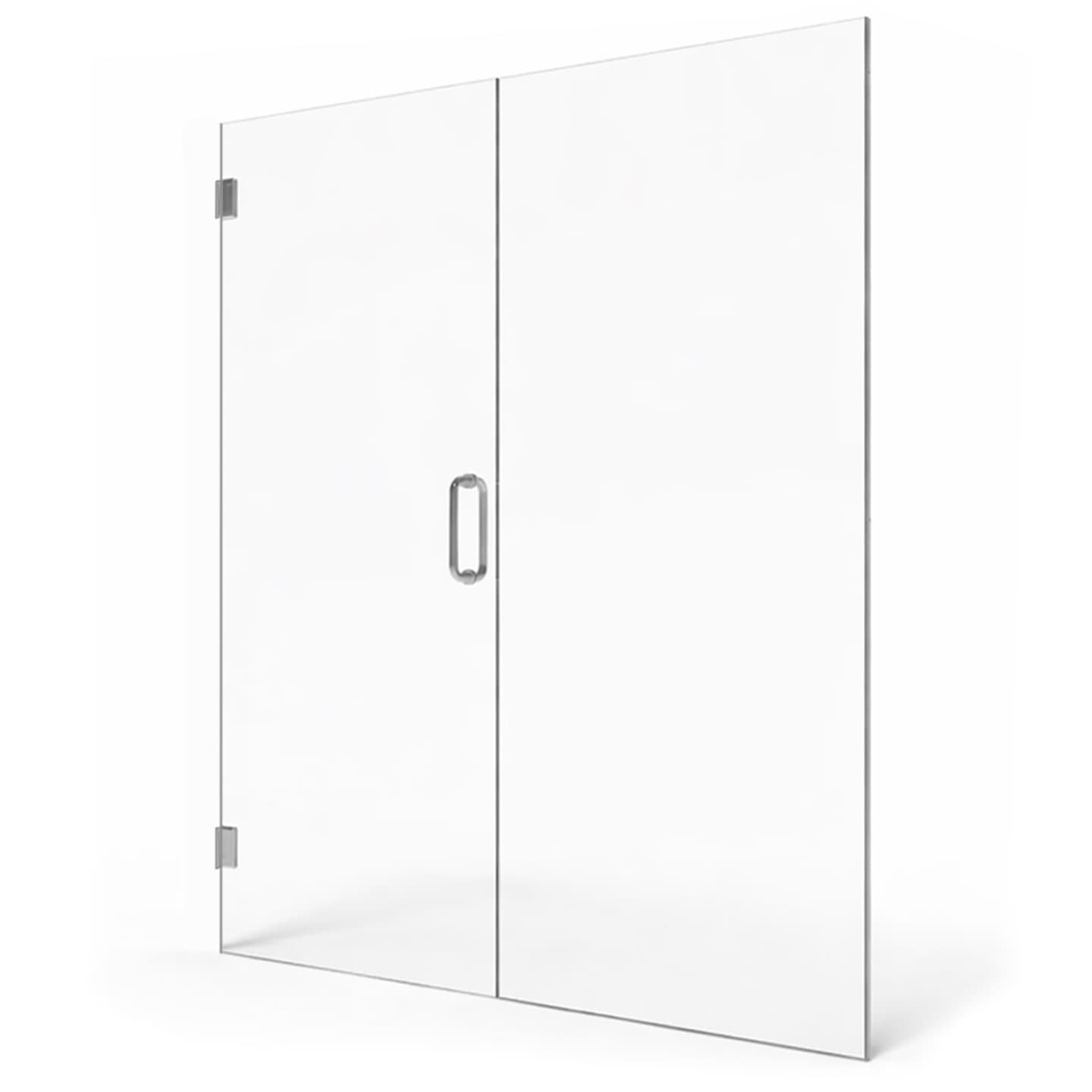
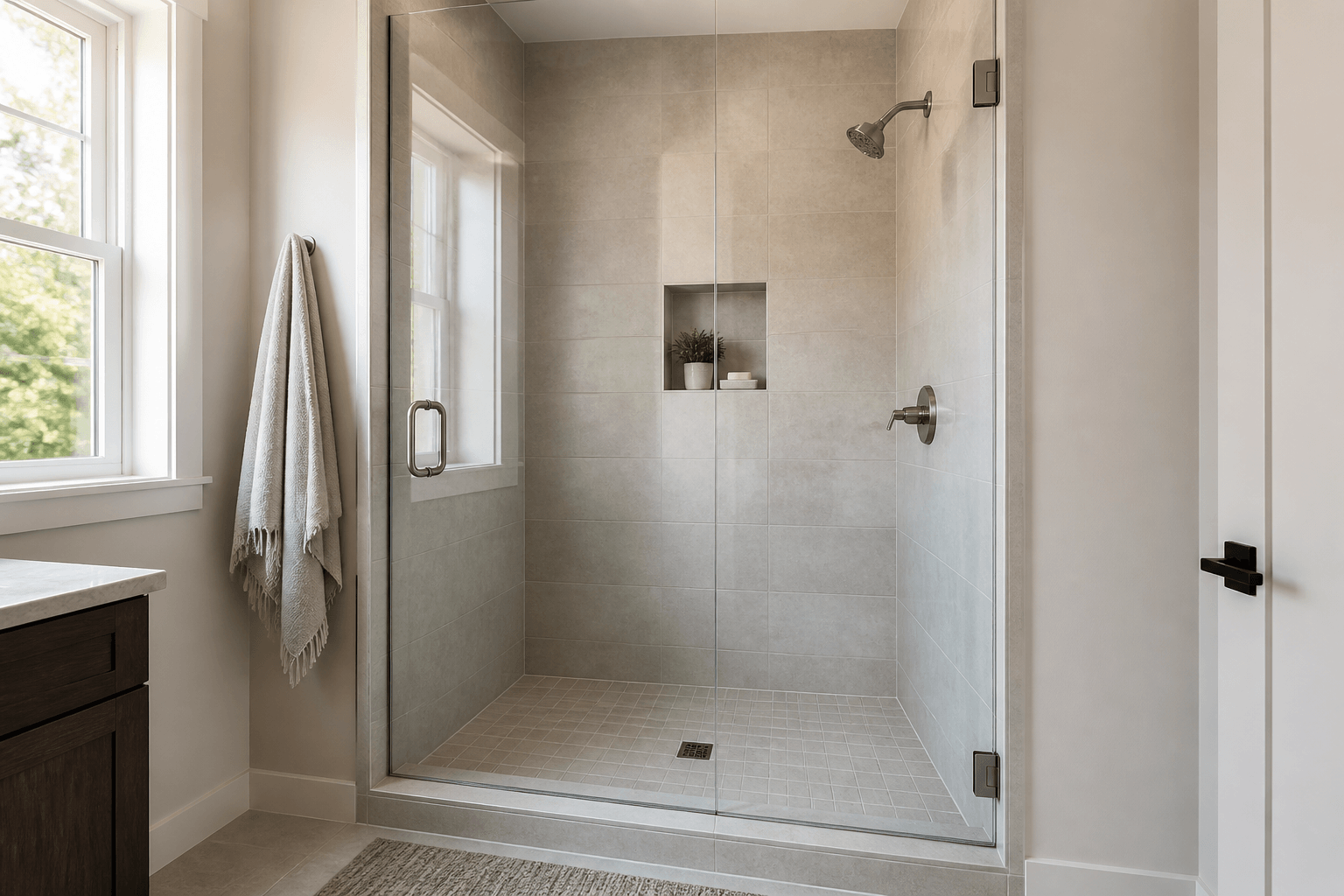
The showerhead should generally be placed as far from the door or open entry as the layout reasonably allows, with its spray aimed toward the shower interior or a solid tiled wall. Avoid directing water at the door’s bottom, vertical edges, hinge gaps, sliding-panel overlap, or doorless opening. If the plumbing wall must be near the entrance, the showerhead angle, glass-panel placement, curb, floor slope, and enclosure hardware become especially important for containing water.
Why does the showerhead’s position matter?
Shower doors contain water, but they are not the same as sealed aquarium walls. Frameless enclosures need functional clearances around moving panels, hinges, and adjacent glass. Sweeps, seals, and thresholds help manage normal spray, but sustained water aimed directly at a gap can escape.
Good showerhead placement reduces how much water reaches these vulnerable areas in the first place. It can also make the shower more comfortable, keep the bathroom floor drier, and reduce the amount of water left on hardware after each use. On the Florida Suncoast, where humidity already slows evaporation, limiting unnecessary overspray can also make routine bathroom care easier.
What is the best position for a hinged shower door?
For a hinged or pivot door, the preferred arrangement usually places the showerhead on a wall where it points away from the door opening. In a rectangular shower, that may mean locating the head on the wall opposite the door or placing it near one end and directing the spray toward the far interior wall.
Pay attention to more than the showerhead’s mounting point. A wall-mounted head can often be angled, so its spray direction matters just as much as its location. The water should not hit the latch-side gap, hinge-side clearance, or bottom sweep head-on. A wide spray pattern may also reach farther than expected even when the center of the spray appears properly aimed.
- Confirm that the showerhead sprays into the enclosure rather than toward the doorway.
- Leave enough bathroom clearance for the door to swing safely without striking a vanity, toilet, towel bar, or wall.
- Consider where the user will stand; water can bounce off the person and travel toward the door even if the head itself points inward.
- Place controls where they can be reached without standing directly under the initial burst of cold or hot water, when the wall and plumbing layout allow it.
- Evaluate the curb or threshold, floor slope, and bottom seal together rather than expecting the door alone to stop water.
How should a showerhead relate to sliding doors?
With sliding shower doors, water should be directed away from the overlap between the glass panels. The specific panel orientation depends on the selected system, but the goal is to prevent spray from being driven through the overlapping seam. This is especially important for tub enclosures, where the showerhead is commonly located at one end of the opening.
Before finalizing the glass, the installer should consider which panel sits toward the wet side, where handles and towel bars will be located, and how the panels overlap. Reversing the intended relationship between the showerhead and panels can leave the seam more exposed to direct spray. Because sliding-system details vary, panel orientation should be confirmed for the actual hardware rather than assumed from another bathroom.
Where should the showerhead go in a doorless shower?
A doorless or walk-in shower needs enough distance and shielding between the showerhead and the open entry. Position the head deeper inside the shower and aim it toward a solid wall whenever possible. A stationary glass panel or splash guard can intercept water that would otherwise travel toward the bathroom floor.
Doorless layouts are particularly sensitive to shower size, spray pattern, user position, and floor drainage. A rainfall head sends water mostly downward and may create less direct horizontal spray than an aggressively angled wall head, but water can still splash off the user and surrounding surfaces. A handheld shower can also send water beyond the opening if its cradle or hose placement makes it easy to point toward the entrance.
- Distance from the showerhead to the open entry
- Width and position of any fixed glass panel
- Direction and width of the showerhead’s spray pattern
- Location of body sprays or handheld shower fixtures
- Slope of the shower floor toward the drain
- Curb or curbless transition details
- Nearby flooring, cabinets, baseboards, and other surfaces that could be exposed to overspray
What if the plumbing wall is next to the door?
Existing plumbing sometimes makes the ideal showerhead location impractical. In that case, the layout can often be improved without moving every pipe. A fixed glass return panel may shield the doorway, while a more adjustable or narrower-pattern showerhead can direct water toward the interior. The door may also be moved to another section of the enclosure if the shower dimensions and surrounding bathroom provide safe access.
Do not rely on adding more sealant as the primary solution to poor spray direction. Sealant is important at appropriate glass and hardware connections, but it cannot turn a frameless door into a completely waterproof barrier. The better approach is to manage water through fixture direction, glass placement, floor slope, drainage, seals, and sensible user access.
Plan the showerhead and glass together
Shower glass should not be planned as an isolated finishing item. Before installation, review the showerhead height and angle, control location, door type, glass-panel arrangement, curb, drain, and nearby bathroom fixtures. The shower should generally be measured after the tile, curb, thresholds, and other finished surfaces affecting glass dimensions are complete and fully cured.
Shower Doors of Sarasota creates custom shower glass for homes in Sarasota, Bradenton, Lakewood Ranch, Venice, and surrounding Suncoast communities. For layout guidance based on your finished opening and fixture locations, request a free quote through the online tool at /quote.
Key Takeaways
- Place the showerhead away from the door or open entry whenever possible.
- Aim spray toward the shower interior or a solid tiled wall.
- Avoid direct spray at door gaps, bottom sweeps, and sliding-panel overlaps.
- Doorless showers need adequate distance, floor drainage, and often a fixed splash panel.
- Plan the fixture direction, door, glass panels, curb, and drain as one water-management system.
- No frameless shower enclosure should be considered completely waterproof.
Ready to Transform Your Bathroom?
Contact us for a free consultation on custom frameless shower doors, enclosures, and mirrors for your Sarasota home.
Frequently Asked Questions
Related Services
Suncoast Team
Sarasota's Trusted Shower Door Experts