
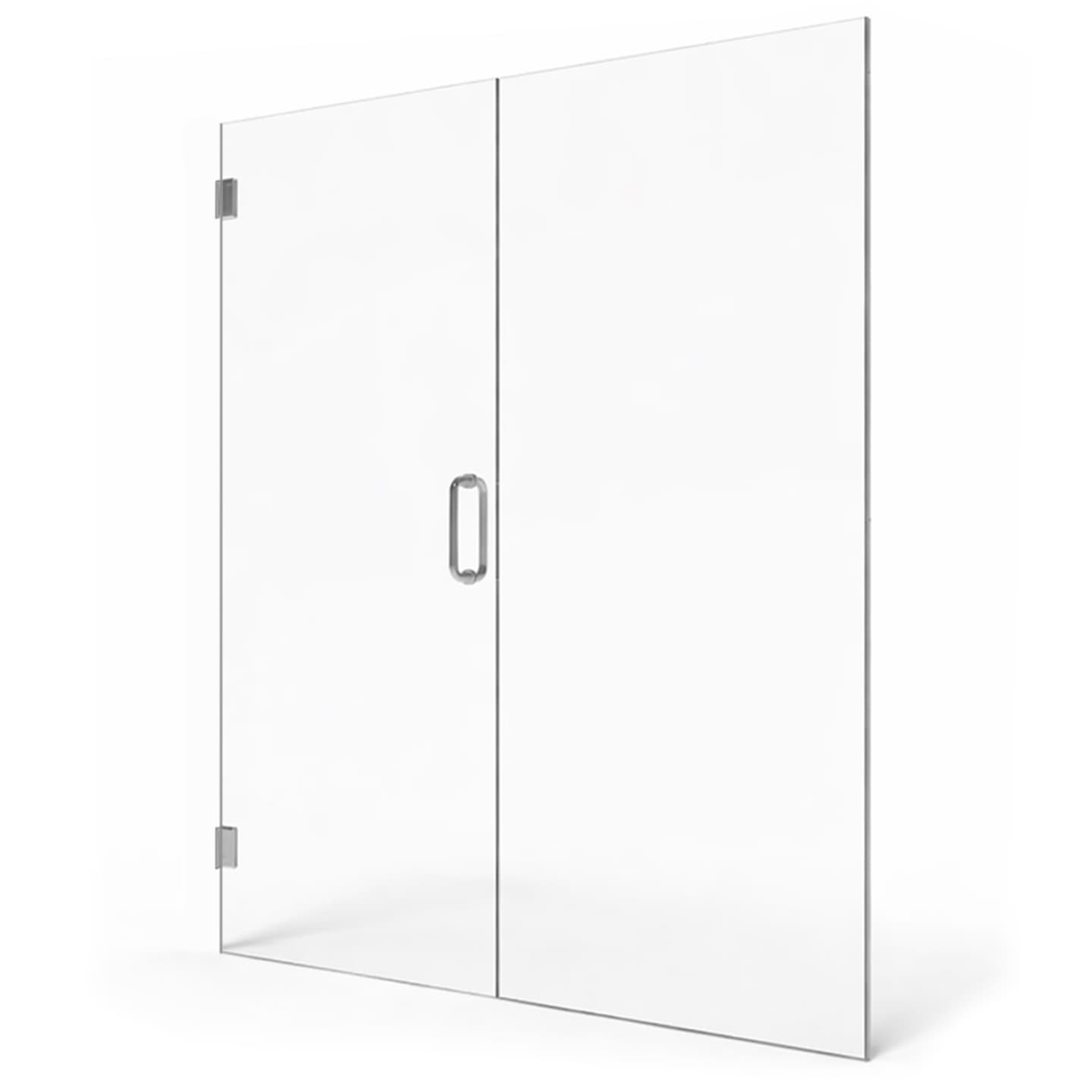

A 1/2-inch fixed shower panel is worth considering when the glass is unusually tall or wide, the design calls for greater stiffness or a more substantial appearance, or the support plan can safely accommodate its added weight. It is not automatically better than 3/8-inch glass, and thickness alone does not make a panel stable or watertight. The final decision should be based on the panel’s exact dimensions, attachment locations, wall construction, hardware, and exposure to daily use.
What does thicker glass change?
For two panels with the same height and width, 1/2-inch glass is more resistant to flexing than 3/8-inch glass. That additional stiffness can make a large panel feel more substantial when touched and may better suit an oversized, open-concept shower. It also creates a thicker visible edge, which some homeowners prefer in bathrooms with large-format stone, heavy countertops, or bold architectural details.
The tradeoff is weight. A 1/2-inch panel contains about one-third more glass than a 3/8-inch panel of the same dimensions, so it is also about one-third heavier. That affects handling, hardware selection, anchoring, and the structure supporting the panel. The added weight is one reason glass thickness cannot be selected only from a photo or a rough opening size.
When is 1/2-inch glass worth considering?
There is no single width or height at which every fixed panel must switch to 1/2-inch glass. A tall, narrow panel behaves differently from a short, wide one, and a panel secured at multiple edges behaves differently from one with a largely unsupported outer edge. Still, several conditions make a 1/2-inch option worth discussing.
- The panel is especially tall, wide, or both, creating a large unsupported glass area.
- The exposed outer edge needs greater stiffness because the design uses minimal visible support.
- The shower has an oversized, architectural look and a thicker glass edge fits the intended proportions.
- The panel is near a circulation path where people may occasionally steady themselves against it—although shower glass should never be treated as a grab bar.
- The layout includes a return panel, transom, bench, half wall, or other condition that makes the support geometry more complex.
- The selected glass type is available in 1/2-inch thickness and the supporting surfaces can accept the required hardware.
These factors do not mean 1/2-inch glass is always required. A properly designed 3/8-inch panel can be appropriate for many substantial fixed-panel installations. The goal is to use the thickness and support system that work together for the specific enclosure—not to specify the thickest glass by default.
Support matters as much as thickness
A fixed shower panel transfers its weight and everyday loads into the curb, floor, wall, ceiling, or adjacent glass through channels, clamps, brackets, or other hardware. The location and quality of those attachment points are critical. Tile itself is a finished surface; the assembly behind it must also be suitable for the planned fastening method.
This is particularly important during a renovation. Blocking and other structural preparation are easiest to address before walls are closed and tile is installed. If the shower is already finished, the installer must evaluate the existing layout and determine an appropriate attachment plan rather than assuming that thicker glass will compensate for limited support.
Where applicable hardware must be installed through tile, drilled openings require careful preparation, sealing, anchoring, and fastening. Shower Doors of Sarasota includes its DoubleSil layered sealing and anchoring process at applicable drilled attachment points. DoubleSil adds protection within the drilled opening as well as an exterior seal, but it cannot guarantee against every possible source of water intrusion.
Will thicker glass improve water containment?
Not by itself. Water containment is primarily influenced by the panel’s position, width, showerhead direction, curb or floor pitch, and the gaps required by the enclosure design. A thicker fixed panel may be stiffer, but it does not block water that travels around its exposed edge.
This distinction matters in walk-in and doorless showers. A larger splash guard can intercept more spray, but the room available for entry and the direction of water flow still matter. Body sprays or a showerhead aimed toward the opening can send water beyond even a substantial panel. No frameless enclosure should be described as completely waterproof because functional gaps remain around glass and doors.
How does glass choice affect the decision?
Thickness is only one part of the appearance. Standard clear glass contains iron that creates a subtle green hue, particularly along a thick exposed edge. That edge color can become more noticeable with 1/2-inch glass. Low-iron glass significantly reduces the green tint and offers more neutral color clarity, which can be valuable when the panel is intended to showcase white tile, pale stone, or detailed finishes.
Shower Doors of Sarasota offers 1/2-inch options in standard clear, low-iron clear, standard frosted, and low-iron frosted glass. Frosted glass is acid-etched on the exterior while the shower-facing interior remains smooth for easier cleaning. Other decorative glass choices may have different thickness limitations, so the desired pattern or tint should be selected before the panel is engineered.
An optional EnduroShield protective coating can be applied to any glass type. It makes the surface easier to clean and reduces water spots, soap scum, and mineral buildup by up to 90%, which can be helpful in Suncoast homes where hard-water deposits often show on large expanses of glass.
What should be finalized before ordering?
Glass dimensions should be based on finished conditions, not framing dimensions or an early tile estimate. The shower should generally be measured after tile, curbs, thresholds, and other surfaces affecting the glass are complete. Shower Doors of Sarasota prefers to measure after tile and waterproofing are fully cured, then fabricate the enclosure to those completed conditions.
- The finished panel height and width
- Which edges will be supported and which will remain exposed
- Whether the walls, curb, half wall, or ceiling can accept the proposed attachments
- The clearance needed for entry, cleaning, fixtures, and nearby doors or cabinets
- The direction of the showerhead and likely splash path
- The desired glass type, edge appearance, hardware finish, and protective coating
- How the panel will be safely carried into the bathroom and positioned during installation
The practical bottom line
Choose 1/2-inch glass because the panel dimensions, support strategy, or visual design benefits from it—not simply because it sounds more premium. For many fixed panels, 3/8-inch tempered glass provides the desired balance of strength, weight, and appearance. For oversized or minimally supported designs, 1/2-inch glass may provide useful stiffness and the substantial edge homeowners want. A field measurement and layout review are the reliable ways to decide. Shower Doors of Sarasota offers free quotes at /quote for projects in Sarasota, Bradenton, Lakewood Ranch, Venice, and surrounding Florida Suncoast communities.
Key Takeaways
- 1/2-inch glass is stiffer but about one-third heavier than an equal-size 3/8-inch panel.
- Panel dimensions, unsupported edges, hardware, and wall construction matter as much as thickness.
- Thicker glass does not make a walk-in or frameless shower waterproof.
- Low-iron glass reduces the green edge tint that can be more visible in thick glass.
- Measure after tile, curbs, thresholds, and other glass-adjacent finishes are complete.
Ready to Transform Your Bathroom?
Contact us for a free consultation on custom frameless shower doors, enclosures, and mirrors for your Sarasota home.
Frequently Asked Questions
Related Services
Suncoast Team
Sarasota's Trusted Shower Door Experts