
Tempered shower glass usually breaks because an edge or corner was damaged, the panel received a hard impact, mounting hardware created concentrated stress, the glass experienced an extreme temperature difference, or a rare internal inclusion caused delayed failure. Some warning signs—such as chips, door misalignment, rubbing, or loose hardware—can be spotted early. However, microscopic edge damage and internal inclusions may cause a panel to break without any visible warning.
Why does tempered glass break into small pieces?
Tempered glass is heated and rapidly cooled during manufacturing. This process places the surface into compression and the interior into tension, making the finished panel substantially stronger than ordinary annealed glass. If damage penetrates that protective surface or reaches a vulnerable edge, the stored tension can release across the entire panel. The glass then breaks into many small pieces rather than the large, sharp shards associated with ordinary glass. Those pieces are safer, but they can still cause cuts and should be handled carefully.
The most common causes of shower-glass breakage
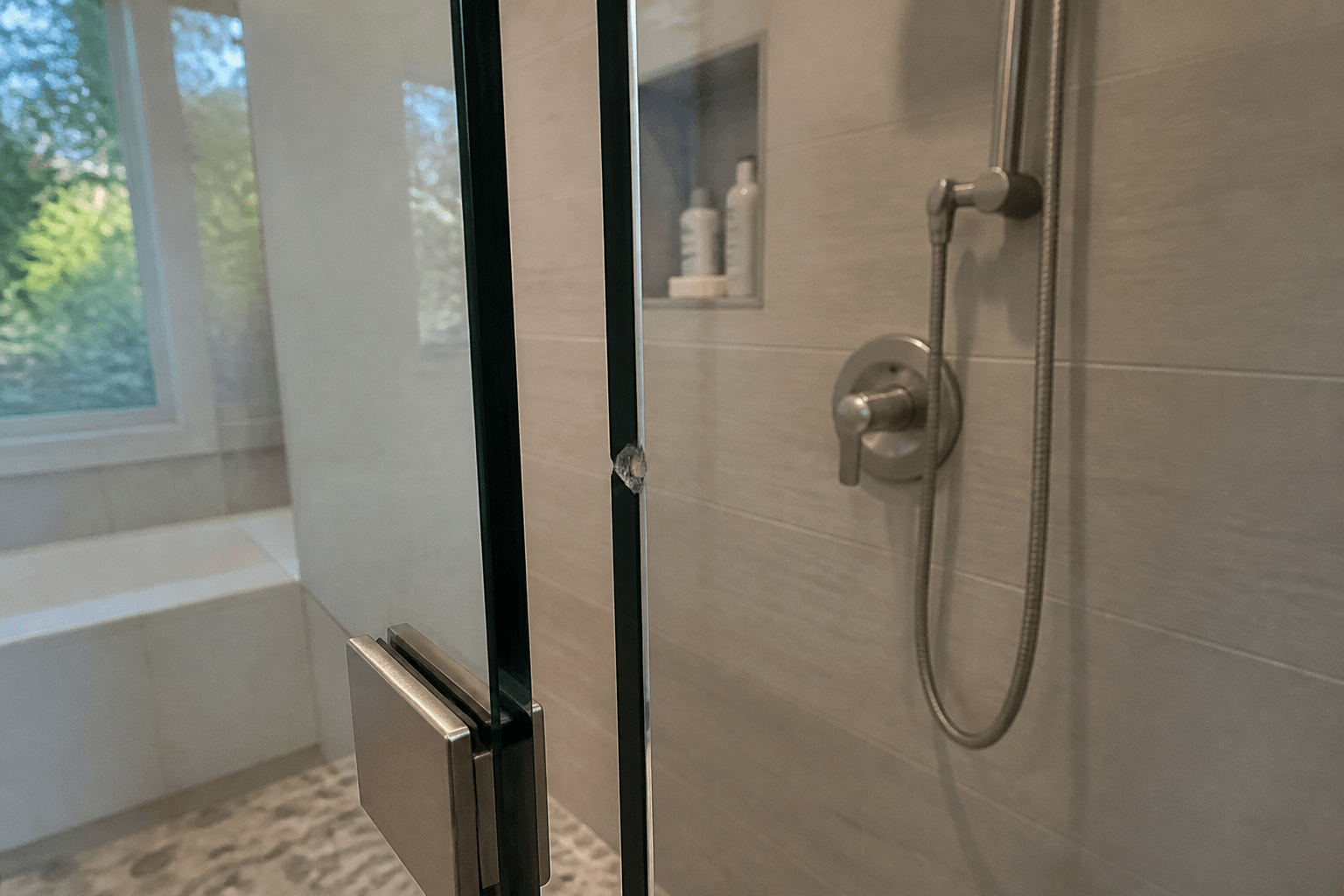
- Edge or corner damage: The face of tempered glass is strong, but its edges and corners are comparatively vulnerable. A small chip caused during handling, installation, cleaning, or everyday use can weaken the panel.
- Direct impact: A showerhead, heavy bottle, cleaning tool, metal handle, or other hard object can strike the glass. An impact near an edge is especially concerning, although a strong blow anywhere can cause failure.
- Concentrated installation stress: Hinges, clamps, channels, fasteners, and protective gaskets must hold the panel without creating improper glass-to-metal or glass-to-tile contact. Misalignment, shifted components, or excessive pressure can concentrate force at one point.
- Movement or misalignment: A sagging door, loose hardware, or movement in surrounding materials can change the panel’s clearances. Glass that begins rubbing against tile, a curb, another panel, or exposed metal needs prompt attention.
- Extreme, uneven temperature changes: Tempered glass tolerates heat better than ordinary glass, and normal shower use should not generally cause failure by itself. Risk can increase when one area is heated or cooled much faster than the rest of the panel.
- Rare internal inclusions: A tiny nickel sulfide inclusion can occasionally remain inside tempered glass. Changes in the inclusion over time may place enough internal pressure on the panel to cause delayed breakage. This is uncommon and generally cannot be identified through a normal visual inspection.
Can shower-glass damage be spotted before it breaks?
Sometimes. Visible edge damage, changing door alignment, and hardware problems can provide useful warnings. Unfortunately, a panel can also contain a hidden internal inclusion or microscopic flaw that cannot be seen from the outside. An inspection can identify observable problems, but it cannot guarantee that tempered glass will never break.
- A chip, flake, notch, or rough spot along an exposed edge or corner
- A visible crack, even if it appears short or does not seem to be spreading
- A door that suddenly drags, catches, drops, or no longer closes normally
- Glass touching tile, stone, metal, or another glass panel where a clearance previously existed
- Loose handles, hinges, clamps, channels, or fasteners
- New popping, clicking, scraping, or grinding sounds when the door moves
- A shifted gasket, setting block, seal, or other component around the glass
How should homeowners inspect shower glass safely?
Look over the enclosure in bright, angled light after cleaning it. Florida hard-water deposits and soap residue can hide small edge defects, so inspect the actual glass rather than judging through mineral buildup. Check exposed edges without running bare fingers along them, and watch the door as it opens and closes. The movement should remain smooth, with consistent gaps and no contact against hard surfaces.
Do not press on a questionable area, tighten shower hardware aggressively, or attempt to fill a chip with household adhesive. Tempered glass cannot be safely cut, drilled, or repaired after tempering. If its structural condition is uncertain, the appropriate solution may be professional evaluation and replacement rather than an improvised repair.
What should you do if a panel suddenly shatters?
Keep people and pets out of the bathroom, put on sturdy closed-toe shoes, and avoid touching pieces that remain attached to hinges, clamps, or channels. Tempered fragments may be small, but their edges can still cut. Do not operate a connected door or panel because the remaining hardware and glass may be unstable.
- Photograph the enclosure, hardware, surrounding tile, and debris before cleanup if it is safe to do so.
- Contact a qualified shower-glass professional to assess the opening and determine what must be replaced.
- Use gloves, a broom, and a suitable vacuum when cleaning loose fragments; check bath mats, tracks, corners, and nearby rooms for small pieces.
- Do not reuse damaged tempered glass or assume an apparently intact connected panel is properly supported after the break.
Practical ways to reduce the risk of damage
- Do not slam a swinging or sliding shower door.
- Keep heavy bottles and metal accessories where they cannot fall against the glass.
- Use soft, nonabrasive cleaning tools and avoid striking edges with vacuum attachments or squeegee handles.
- Have dragging doors, loose hardware, or changing gaps evaluated instead of forcing the door.
- Do not hang extra weight from handles or towel bars unless the component is designed for it.
- Remember that a water-repellent protective coating makes glass easier to clean; it does not reinforce the panel or prevent impact breakage.
Planning a safe replacement or new enclosure
Accurate measurement, suitable clearances, correct hardware, and careful handling all matter with custom shower glass. Shower Doors of Sarasota uses tempered safety glass fabricated and tempered in Sarasota and serves homeowners throughout Sarasota, Bradenton, Lakewood Ranch, Venice, and the surrounding Florida Suncoast. Homeowners planning a new enclosure or replacing broken shower glass can request a free quote at /quote.
Key Takeaways
- Tempered glass is strongest across its broad surface and most vulnerable at its edges and corners.
- Chips, rubbing, misalignment, loose hardware, and unusual sounds deserve prompt attention.
- Rare internal inclusions and microscopic damage may cause breakage without a visible warning.
- Normal shower heat is not usually the sole cause; extreme, uneven temperature changes are a greater concern.
- Damaged tempered glass cannot be safely repaired, cut, or drilled after tempering.
Ready to Transform Your Bathroom?
Contact us for a free consultation on custom frameless shower doors, enclosures, and mirrors for your Sarasota home.
Frequently Asked Questions
Suncoast Team
Sarasota's Trusted Shower Door Experts