
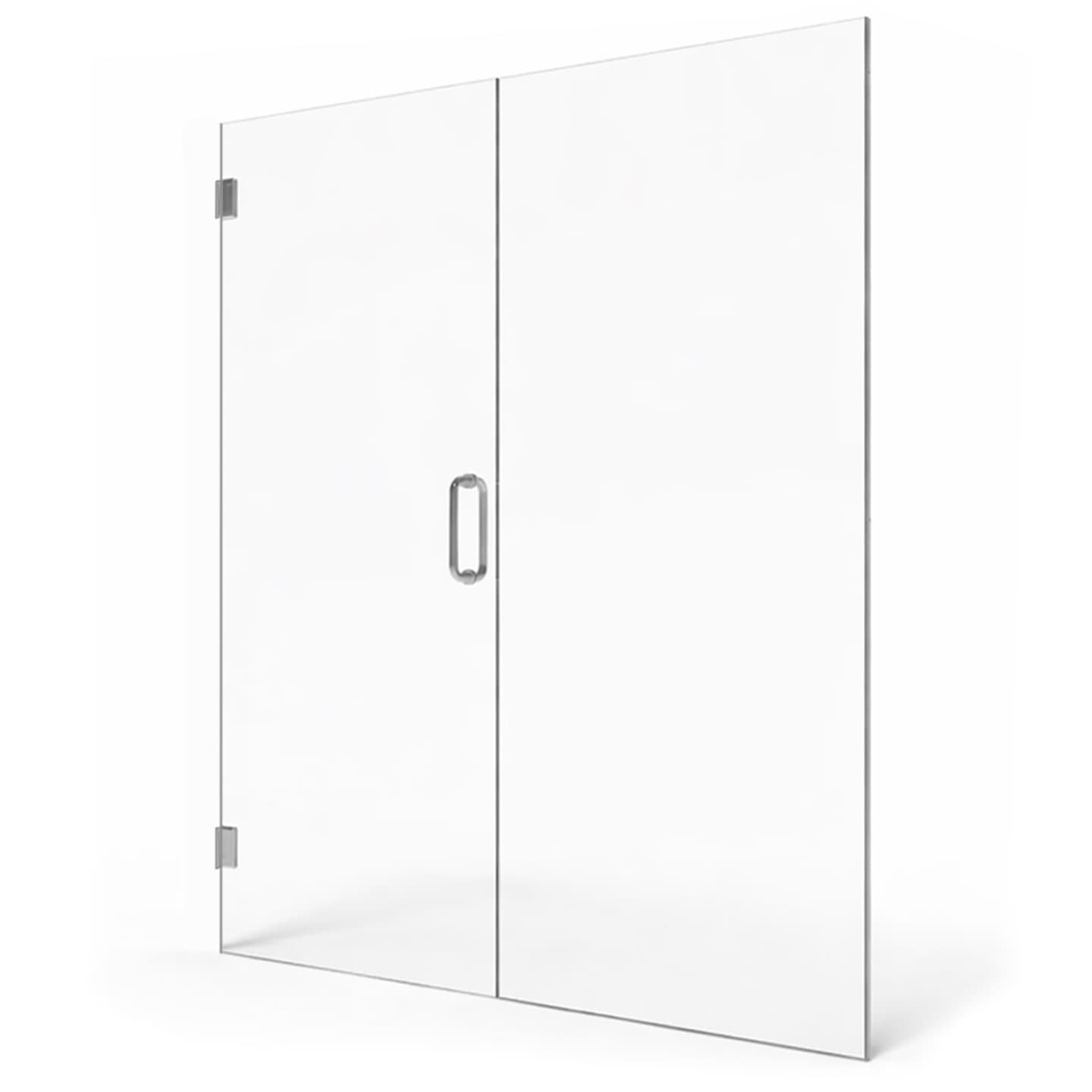
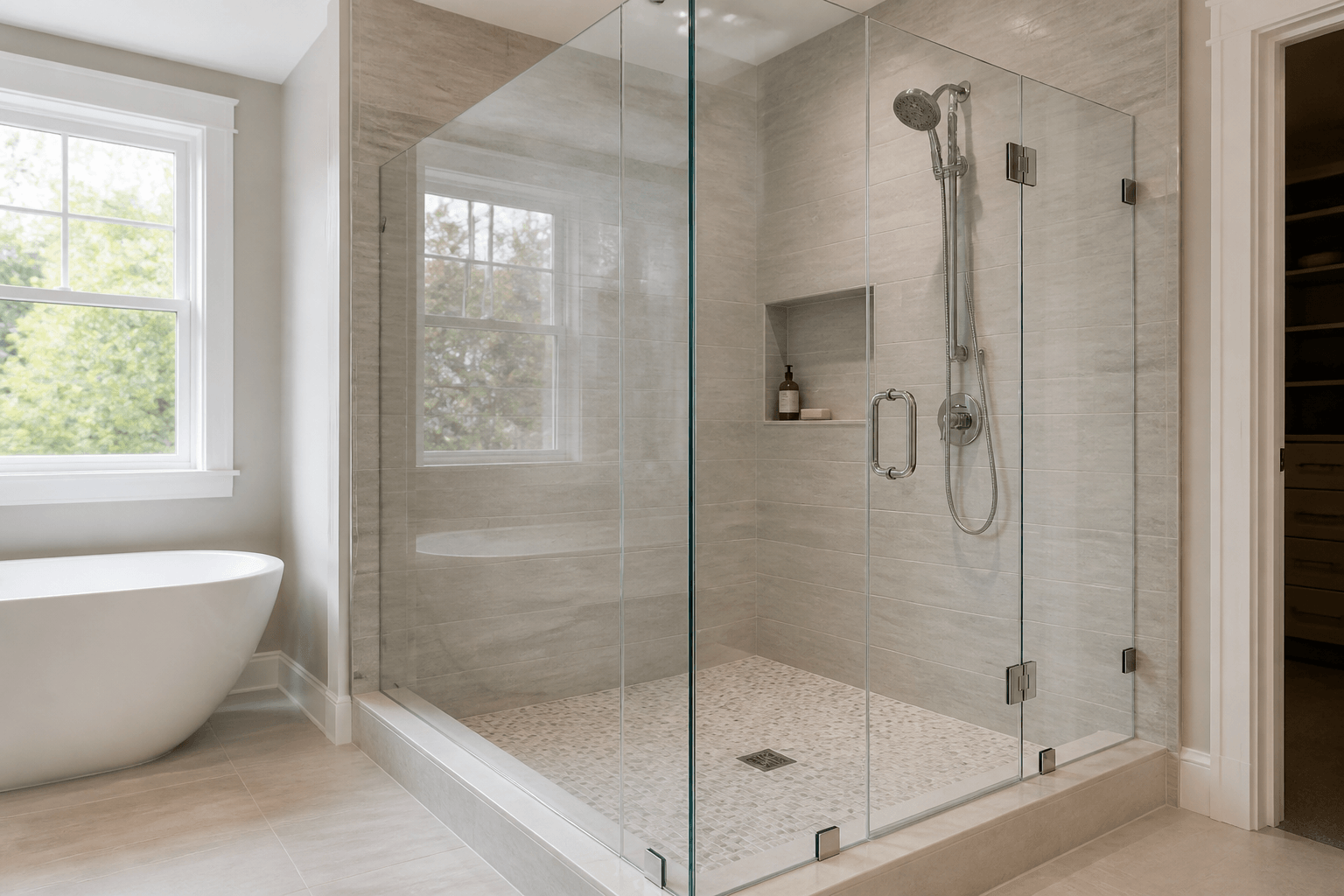
For most frameless shower enclosures, 3/8-inch tempered glass provides a practical balance of strength, stability, weight, and cost. Large or especially tall frameless panels may call for 1/2-inch glass, while thinner glass such as 1/4 inch is commonly used in framed or semi-frameless systems where metal components provide more support. The correct thickness must be selected for the complete enclosure—not by appearance alone—because panel size, door movement, hardware, wall construction, and layout all affect what will work safely.
What Do the Common Shower Glass Thicknesses Mean?
Shower glass is available in several thicknesses, but the glass cannot be considered separately from the frame and hardware. A fully framed enclosure supports the edges of the glass with metal framing. Frameless designs rely more heavily on the rigidity of the glass, carefully positioned hinges or clamps, and secure attachment points.
- 1/8 inch: A lightweight option generally associated with framed systems in which the surrounding frame supplies substantial support.
- 3/16 inch: Often used in framed or some semi-frameless configurations, depending on the system design.
- 1/4 inch: Suitable for many framed and semi-frameless doors, panels, and sliding systems. It is lighter than typical heavy frameless glass.
- 3/8 inch: A widely used choice for frameless doors and panels because it offers good rigidity without the additional weight of 1/2-inch glass.
- 1/2 inch: Used where the design, dimensions, or desired feel justify heavier glass and the walls and hardware can support it.
- 3/4 inch: Available for specialized applications, but not a routine choice for a residential shower enclosure.
Shower Doors of Sarasota offers multiple glass types and thicknesses. Available combinations vary: for example, clear glass is offered in a broader range of thicknesses, while rain, reeded, gray, and bronze glass are available in 3/8 inch. Frosted glass is available in 3/8 inch or 1/2 inch. This means the preferred pattern or tint can narrow the practical thickness choices.
Is 3/8-Inch Glass Enough for a Frameless Shower?
In many residential frameless enclosures, yes. A properly designed 3/8-inch system can provide the substantial look and stable feel homeowners expect from frameless glass. It is also lighter than 1/2-inch glass, which reduces the load placed on hinges and attachment points.
That does not mean every opening should use 3/8-inch glass. An unusually wide door, tall panel, limited bracing, or complex layout may change the requirements. Likewise, a smaller enclosure does not benefit automatically from heavier glass. The system should be designed around the actual finished opening and the hardware approved for that layout.
When Does 1/2-Inch Shower Glass Make Sense?
Half-inch glass may be appropriate for large fixed panels, tall enclosures, or designs that need additional rigidity. Some homeowners also prefer its heavier visual presence and substantial feel. However, it weighs roughly one-third more than 3/8-inch glass of the same dimensions, so the hinges, clamps, walls, and other supporting elements must be selected accordingly.
Heavier is not automatically safer or better. Installing 1/2-inch glass where the wall structure or hardware is not suited to the load can create unnecessary complications. It may also limit hardware choices and raise project cost without improving the enclosure’s day-to-day performance. Thickness should solve a design or structural need rather than serve as a standalone upgrade.
How Do Enclosure Style and Layout Affect Thickness?
Different enclosure styles support and move glass in different ways. A swinging door concentrates weight at its hinges, while a sliding door transfers loads through its rolling or track system. A stationary panel does not move, but its height, width, and exposed edges affect how much rigidity and support it needs.
- Door width and height: A larger door is heavier and places more demand on hinges and attachment points.
- Fixed-panel dimensions: Tall or wide panels may need thicker glass, additional support, or both.
- Framing: Full frames and channels provide more edge support than minimal frameless hardware.
- Door clearance: A swinging door needs enough unobstructed room to operate without striking a vanity, toilet, towel bar, or adjacent glass.
- Wall construction: Hinges and clamps need appropriate attachment conditions; tile itself should not be treated as the sole structural support.
- Curb and wall alignment: Out-of-plumb walls and sloped surfaces must be accounted for in the custom measurements.
- Glass style: Textured, tinted, low-iron, and frosted products are not necessarily offered in every thickness.
Does Thicker Glass Prevent Shower Leaks?
No. Glass thickness affects rigidity, weight, hardware requirements, and the feel of the enclosure, but it does not make a shower waterproof. Frameless enclosures have functional gaps around doors and panels. Water control depends on the overall layout, curb slope, showerhead direction, panel placement, seals, and proper installation—not simply on using thicker glass.
Drilled hardware locations also require careful preparation. Shower Doors of Sarasota includes its DoubleSil layered sealing and anchoring process with applicable installations. DoubleSil adds protection within drilled openings before anchors and fasteners are fully installed, along with the visible exterior seal. It is an added precaution at those attachment points, not a guarantee against every possible source of water intrusion.
Should Glass Thickness Be Chosen Before Tile Is Finished?
You can discuss the likely enclosure style and thickness during bathroom planning, especially if the walls may need backing for hardware. Final glass dimensions should generally be taken after the tile, curb, thresholds, and other surfaces affecting the opening are complete. Shower Doors of Sarasota likes to measure after tile and waterproofing are fully cured, then fabricate and install the enclosure.
This order matters because tempered glass cannot be cut, drilled, or resized after tempering. Exact dimensions and hardware-hole locations must be established before fabrication. All glass supplied by Shower Doors of Sarasota is fabricated and tempered in Sarasota, Florida. If tempered safety glass breaks, it is designed to shatter into small pieces rather than large, sharp shards.
How to Make the Final Choice
Start with the enclosure type and the finished opening rather than choosing a thickness from a sample. For many frameless showers, 3/8 inch will be the leading option. Consider 1/2 inch when larger dimensions, support conditions, or the intended design make its added rigidity worthwhile. Framed and semi-frameless systems may use thinner glass because their metal components perform more of the supporting work.
A professional measurement allows the complete system to be evaluated together: glass thickness, panel dimensions, hinge capacity, fixed-panel support, wall conditions, clearances, and preferred glass style. Homeowners in Sarasota, Bradenton, Lakewood Ranch, Venice, and surrounding Suncoast communities can request a free quote from Shower Doors of Sarasota at /quote.
Key Takeaways
- 3/8-inch glass is a common, well-balanced choice for residential frameless enclosures.
- 1/2-inch glass may suit large or tall panels but requires hardware and walls capable of supporting its extra weight.
- Framed and semi-frameless systems can often use thinner glass because the metal framing provides support.
- Glass thickness does not make an enclosure waterproof or eliminate functional gaps.
- Final thickness should be selected with the enclosure layout, dimensions, hardware, wall construction, and glass style in mind.
Ready to Transform Your Bathroom?
Contact us for a free consultation on custom frameless shower doors, enclosures, and mirrors for your Sarasota home.
Frequently Asked Questions
Related Services
Suncoast Team
Sarasota's Trusted Shower Door Experts