
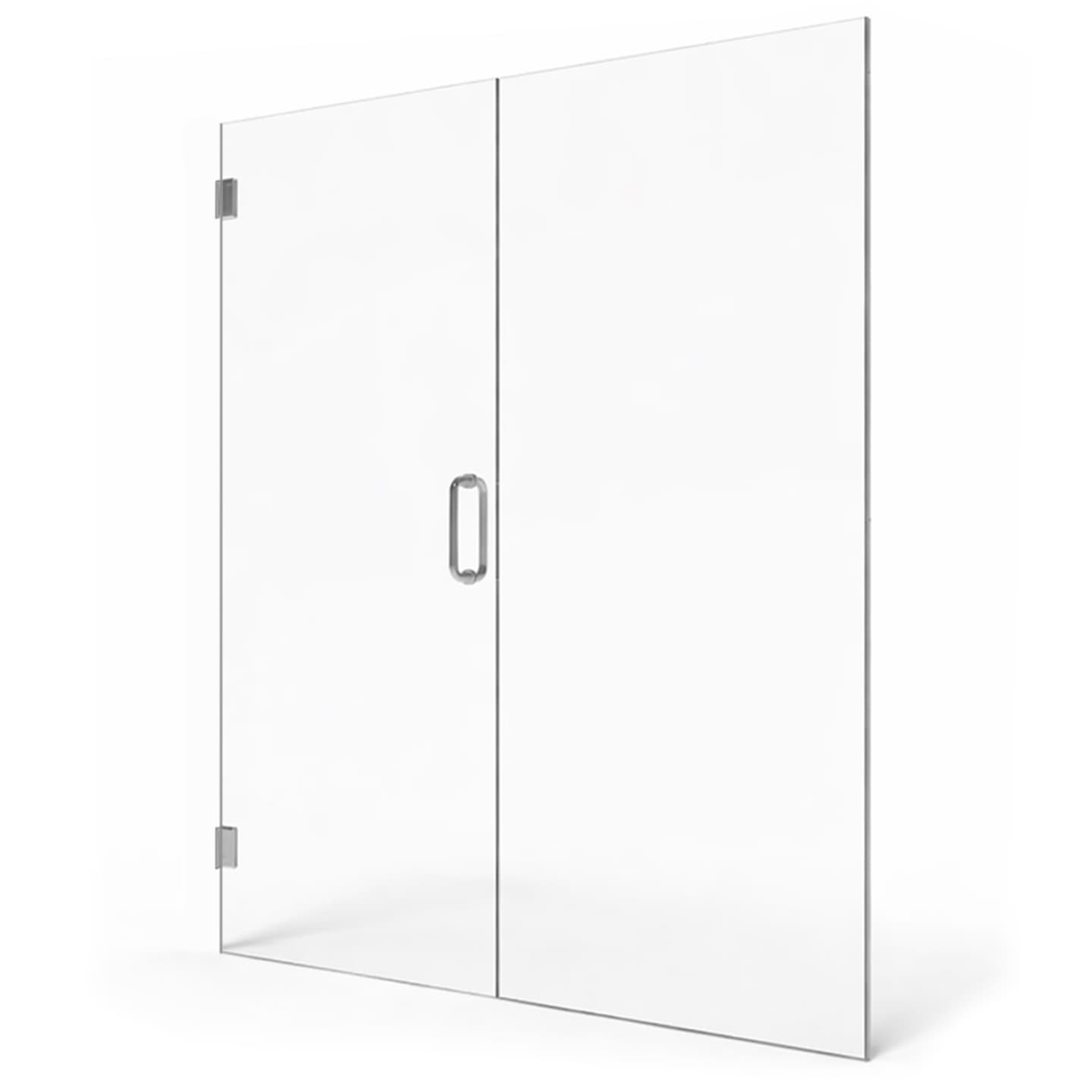
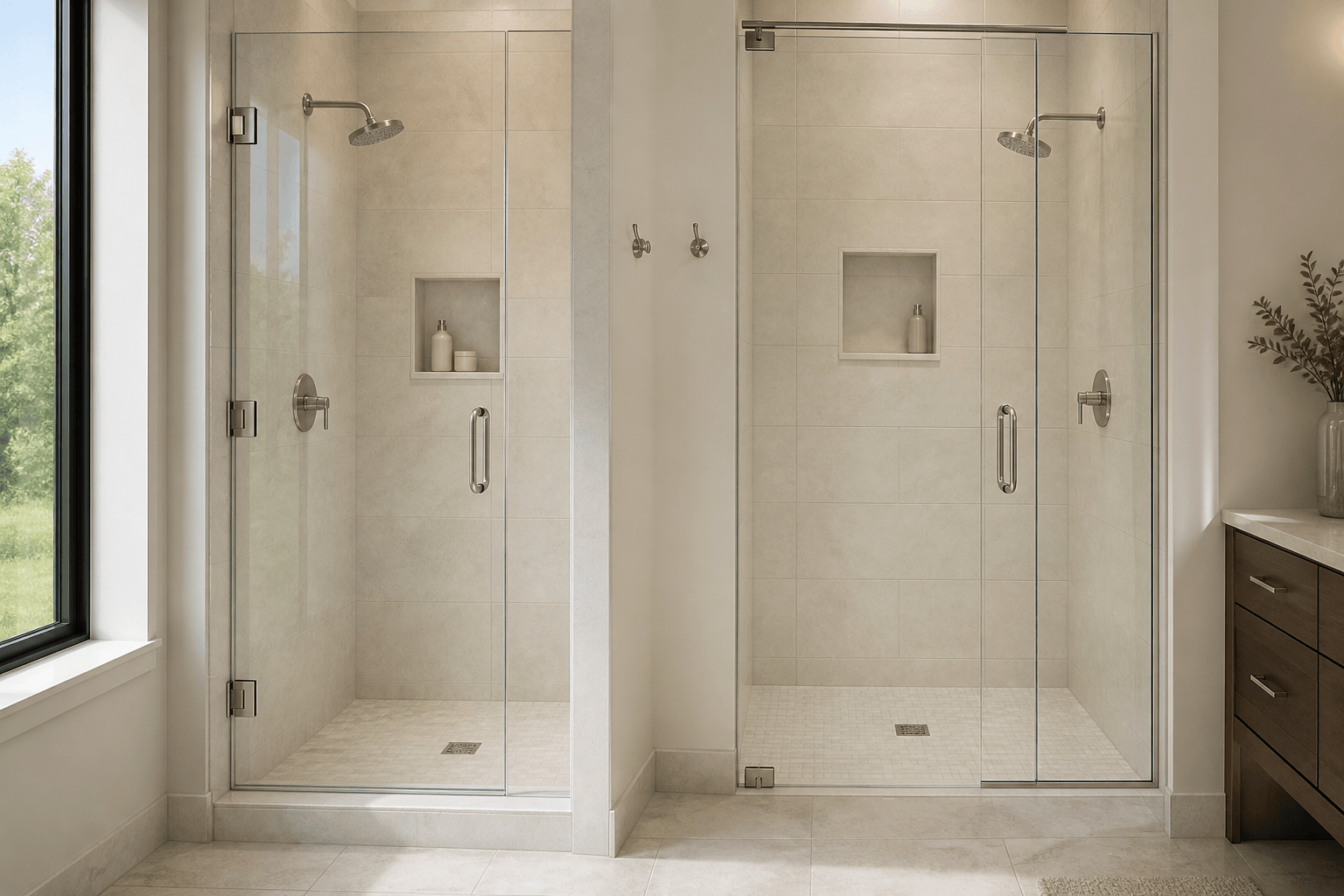
Top-and-bottom pivot hinges support a shower door at its upper and lower edges, while wall-mount hinges attach the door along the vertical wall-side edge. That difference affects where the door rotates, how the weight transfers into the enclosure, where drilling may be required, and how the finished shower looks. Neither hinge style is automatically better: wall-mount hinges are often a clean choice when there is a properly prepared wall beside the door, while top-and-bottom pivots can solve layouts involving fixed panels, headers, unusual wall conditions, or a strategically offset swing point.
What is the practical difference between the two hinge styles?
A wall-mount hinge connects the glass directly to the shower wall, typically through finished tile and into suitable structural support. The door swings from points located along its wall-side edge. A top-and-bottom pivot system places the rotating hardware near the top and bottom of the door. Depending on the specific enclosure, the lower pivot may connect at the curb or floor, while the upper pivot may connect to a header, support member, transom, or another compatible part of the glass system.
- Wall-mount hinges transfer the door load toward the vertical wall.
- Top-and-bottom pivots transfer load through upper and lower attachment points.
- Wall-mount doors generally rotate near the door’s outside edge.
- An offset pivot can move the rotation point inward from the edge, changing the door’s sweep.
- Exact hinge locations, swing limits, and support requirements vary by hardware system and enclosure design.
How does the hinge choice change the door swing?
Door-swing geometry is one of the most important differences. A wall-mounted door usually sweeps through the bathroom from the hinged edge, much like a conventional room door. You need enough clearance for the outer corner of the glass to avoid a toilet, vanity, towel bar, nearby wall, or sloped ceiling. A top-and-bottom pivot may place the pivot point several inches inward, so part of the glass rotates into the shower while the remainder rotates outward. That can reduce the door’s outward projection, although it may also use some interior shower space.
Do not assume either hinge type automatically permits both inward and outward operation. Some systems can swing in both directions, while others use stops or are configured for a particular direction. The showerhead location, curb slope, seals, handles, and nearby fixtures all influence which swing direction is practical.
Which option provides a wider usable opening?
The answer depends on the door width and pivot location. Wall-mount hinges place the rotation point close to the side of the opening, so most of the doorway can remain available when the door is open. An offset pivot uses part of the door on both sides of the pivot point, which may reduce the clear passage width. That reduction can matter in a compact opening or for a homeowner planning for easier long-term access.
- The actual clear opening after the door, hinges, seals, and handles are installed.
- Whether the door can open without striking bathroom fixtures or shower controls.
- Whether an inward-swinging portion will interfere with a bench, grab bar, or showerhead.
- Whether the entry remains comfortable for the people who will use the shower.
Wall construction and enclosure layout matter
Wall-mount hinges need more than a flat tile surface. The attachment area must be suitable for the hardware and expected loads, and the finished wall must be evaluated for plumb. Significant out-of-plumb conditions can complicate door alignment and consistent gaps. If you are still remodeling, discuss the planned door location with the contractor before the wall is closed so appropriate support and waterproofing details can be addressed.
Top-and-bottom pivots may help when a door is aligned with a fixed glass panel rather than directly beside a full-height wall. However, they do not eliminate structural planning. The upper and lower attachment points must still be compatible with the curb, ceiling, header, fixed panel, and overall enclosure. A lower pivot can also place hardware near a frequently wet horizontal surface, making careful layout and sealing especially important.
How do the hinges affect the shower’s appearance?
Wall-mount hinges create visible hardware along the tiled wall and leave the top and bottom edges of the door comparatively uninterrupted. They are a familiar choice for frameless enclosures and can emphasize a simple vertical line. Top-and-bottom pivots concentrate the hardware at the horizontal edges, which can make the wall-side edge look cleaner. If the system requires a header or additional support, however, that component becomes part of the visual design.
Hardware finish and alignment often have as much visual impact as hinge type. Coordinate hinges with the door handle, plumbing fixtures, and other bathroom finishes. Also consider the glass itself: low-iron glass provides a more neutral view of tile, while frosted, rain, reeded, gray, or bronze glass changes how prominent the hardware and enclosure lines appear.
Does either hinge style contain water better?
Hinge type alone does not make a shower waterproof. Frameless enclosures have functional gaps around doors and panels, and water containment depends on the entire design: showerhead direction, curb and floor slope, door position, panel dimensions, seals, and normal shower use. A door that directs its bottom sweep over the curb when closing may manage runoff more effectively than a poorly positioned door, regardless of which hinge supports it.
Drilled attachment points also require careful preparation. Shower Doors of Sarasota uses the DoubleSil method at applicable drilled shower-glass hardware attachment points. It incorporates protection inside the drilled opening before the anchor and fastener are fully installed, in addition to the visible exterior seal. This is an added precaution, not a guarantee against every possible source of water intrusion.
What about cleaning and ongoing maintenance?
Both hinge styles are straightforward to maintain when installed and adjusted correctly. Wall-mount hinges create hardware-to-tile edges that should be cleaned gently. Bottom pivot hardware sits close to runoff and may collect more soap residue or hard-water minerals. Sarasota-area hard water and humid conditions make routine drying particularly helpful.
- Use a squeegee after showering to reduce mineral deposits on glass and hardware.
- Clean with mild, nonabrasive products rather than scouring pads or harsh tools.
- Wipe around hinge plates and the lower pivot without picking at sealant.
- Do not hang towels or place body weight on the door or handle.
- Have unusual movement, rubbing, or a changing gap evaluated rather than forcing the door.
How should you choose between pivot and wall-mount hinges?
Choose based on the complete enclosure rather than hardware appearance alone. Wall-mount hinges are often appropriate when the door meets a sound, suitably prepared wall and has a clear swing path. Top-and-bottom pivots may be useful when the layout includes fixed glass, when moving the pivot point improves clearance, or when the intended design calls for hardware at the door’s horizontal edges.
Final hardware selection should be made after the tile, curb, thresholds, and other finished surfaces affecting the glass dimensions are complete and fully cured. Shower glass is fabricated to exact field measurements, and holes or cutouts in tempered glass cannot be added afterward. Shower Doors of Sarasota can evaluate the opening, proposed swing, attachment locations, and glass configuration for homes throughout Sarasota and the surrounding Suncoast. A free project quote is available at /quote.
Key Takeaways
- Wall-mount hinges support the door from the tiled wall; top-and-bottom pivots use upper and lower attachment points.
- An offset pivot can reduce outward projection but may reduce clear entry width or use interior shower space.
- Wall support, curb construction, fixed panels, and finished-surface alignment all affect the correct hardware choice.
- Neither hinge type makes a frameless shower completely waterproof.
- Plan the hinge layout before glass fabrication because tempered glass cannot be field-cut or drilled afterward.
Ready to Transform Your Bathroom?
Contact us for a free consultation on custom frameless shower doors, enclosures, and mirrors for your Sarasota home.
Frequently Asked Questions
Related Services
Suncoast Team
Sarasota's Trusted Shower Door Experts